

Zapmail is a high-volume reseller of Google Workspace and Microsoft 365 mailboxes, with documented complaints about its supply chain. Maildoso is a budget provider that pairs SMTP with Google Workspace and sells no Microsoft 365 at all. Neither one publishes SOC 2 compliance.
For compliant cold email mailboxes you actually own, Primeforge is the stronger choice. Real Google Workspace and Microsoft 365 mailboxes from $4.50 down to $3.50 a month, SOC 2 compliance, and free Warmforge warm-up inside the Forge Stack. No EDU tricks, no resold inboxes.
I've spent the past year setting up cold email infrastructure for outbound teams, and the Zapmail vs Maildoso question comes up almost weekly. Both sell mailboxes built for cold outreach. Both automate DNS. Both cost a few dollars per mailbox.
The differences only show up after you've burned a domain or two. That's when you start caring about who owns the mailbox, where the IPs sit, and what happens when something gets flagged.
This is the two of them compared against Primeforge, the mailbox product I'd point a serious outbound team toward in June 2026. I'll cover what each one is, what each one costs on its live pricing page right now, and where each one breaks.
Cold Email Infrastructure Comparison at a Glance: Zapmail vs Maildoso
Here is the short version before the detail. Every cell is a specific fact you can check on each vendor's live site.
| Feature | Primeforge | Zapmail | Maildoso |
|---|---|---|---|
| Mailbox types | Real Google Workspace + Microsoft 365 | Real Google Workspace + Microsoft 365 (MS365 sold separately) | SMTP + Google Workspace (no Microsoft 365) |
| Entry pricing | $4.50/mailbox/mo, down to $3.50 at volume | Zapmail Starter: $39/mo for 10 Google mailboxes, $3.50/extra | $75/mo for 30 SMTP, or $90/mo combo (15 GW + 15 SMTP) |
| Billing options | Monthly or annual (2 months free annual) | Monthly, quarterly, or yearly (~$2.50/mailbox annual, top tier) | Monthly or quarterly (free domains on quarterly SMTP) |
| Setup time | 30 minutes | ~10 minutes (claimed) | ~15 minutes (claimed) |
| Warm-up | Pre-warmed available; Warmforge warm-up free with Salesforge | Paid add-on | Ramp-up guidance only (15 cold emails/day per GW mailbox) |
| ESP Matching | Yes - both ESPs under one account | Partial - Microsoft 365 is a separate purchase | No - no Microsoft 365 option |
| SOC 2 compliance | Yes | No published certification | No published certification |
| Programmatic access | Forge CLI + MCP server | API on Pro plan only ($299/mo) | API available |
| Refunds | Standard terms | No published refund window; reviewers report a no-refund policy | 30-day money-back guarantee |
| Best for | Teams that need compliant, owned Google/Microsoft mailboxes at scale | Freelancers and small agencies at 10-30 mailboxes on entry budgets | Volume-first agencies comfortable with shared SMTP risk |
Zapmail Overview: Resold Google Workspace and Microsoft 365 Mailboxes at Scale
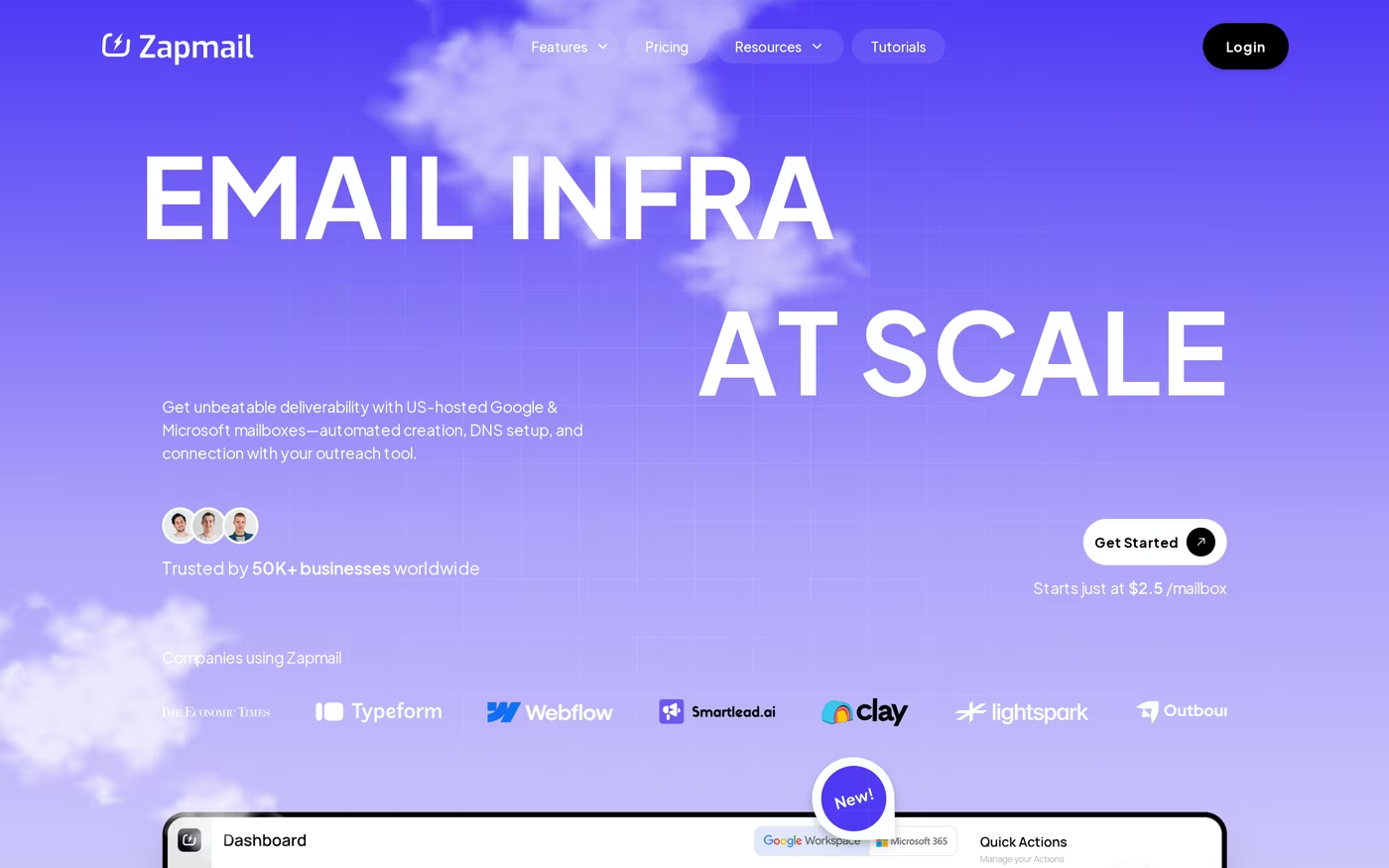
Zapmail is a cold email infrastructure provider that resells discounted Google Workspace and Microsoft 365 accounts, wrapped in automated DNS and a workspace-isolation model. It has scaled fast: the homepage cites 50,000+ businesses, 1M+ mailboxes set up, and 330k+ domains managed. Its Trustpilot TrustScore sits around 4 stars across roughly 76 reviews.
Here is what Zapmail includes:
- Real Google Workspace and Microsoft 365 mailboxes. Microsoft 365 is a separate purchase, not bundled into the headline plans.
- Workspace-level isolation. One domain per workspace, which limits collateral damage when something gets flagged.
- Automated DNS. SPF, DKIM, DMARC, and custom tracking domains configured at provisioning.
- Pre-warmed mailboxes. Sold as a paid add-on, not included in base plans.
- 50+ integrations. Instantly, Smartlead, Lemlist, ReachInbox, Reply, Salesforge, and others connect over OAuth.
- AI tooling. A domain name generator, mailbox name generator, and profile image generator for spinning up sender identities.
- API access. Gated to the Pro plan at $299/mo. Zapmail Starter and Growth users cannot use it.
Zapmail pricing
Three monthly tiers, with quarterly and yearly options that lower the per-mailbox cost:
- Zapmail Starter: $39/mo, 10 Google mailboxes, $3.50 per extra.
- Zapmail Growth: $99/mo, 30 Google mailboxes, $3.25 per extra. Marketed as the most popular plan.
- Zapmail Pro: $299/mo, 100 Google mailboxes, $3.00 per extra, with priority support and API access.
- Annual: two months free brings the top tier to roughly $2.50 per mailbox.
Microsoft 365 is not in the headline price. Pre-warmed mailboxes cost extra, and domains start at $13 for a .com. I ran Zapmail against another provider in the same bracket in my Zapmail vs Mailscale comparison if you want a second data point.
What reviewers say about Zapmail
The Trustpilot page is mostly positive, but the critical reviews keep circling one theme: the supply chain behind the mailboxes.
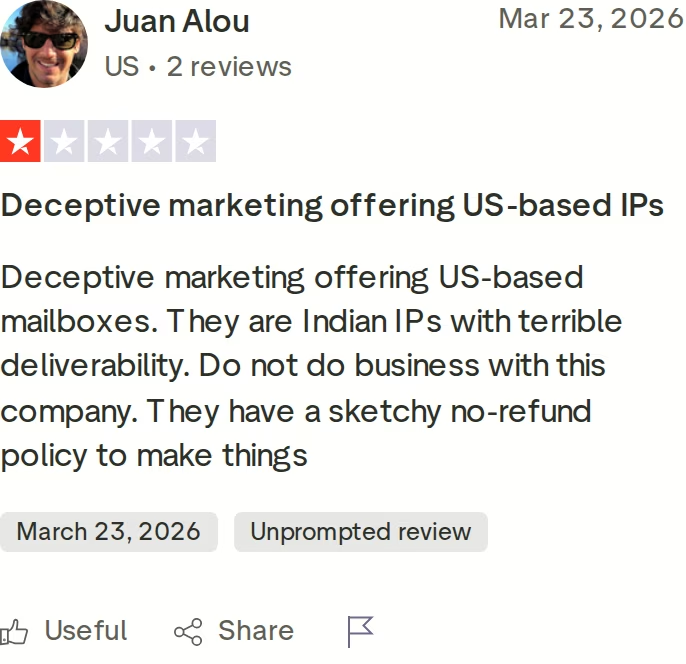
A widely shared r/coldemail thread describes the mechanism: Google Workspace seats provisioned through an India-based reseller at roughly $2 each and resold at $3 to $3.50. The thread explains how to check it yourself - request admin access, open Google Admin Console, and look at the billing section.
To be fair, Zapmail's founder has publicly disputed the deliverability implication. He says sending runs through US-based Google data centers and users can verify via email headers. The more consistent complaint is narrower: several r/coldemail posts over the past year report Zapmail's Microsoft 365 mailboxes disconnecting more often than its Google ones.
Zapmail is aimed at freelancers and small agencies running 10 to 30 Google mailboxes who want the lowest entry price and accept a reseller model. At higher volume, and on Microsoft 365 specifically, the trade-offs stack up.
Maildoso Overview: Budget SMTP and Google Workspace Combo Plans
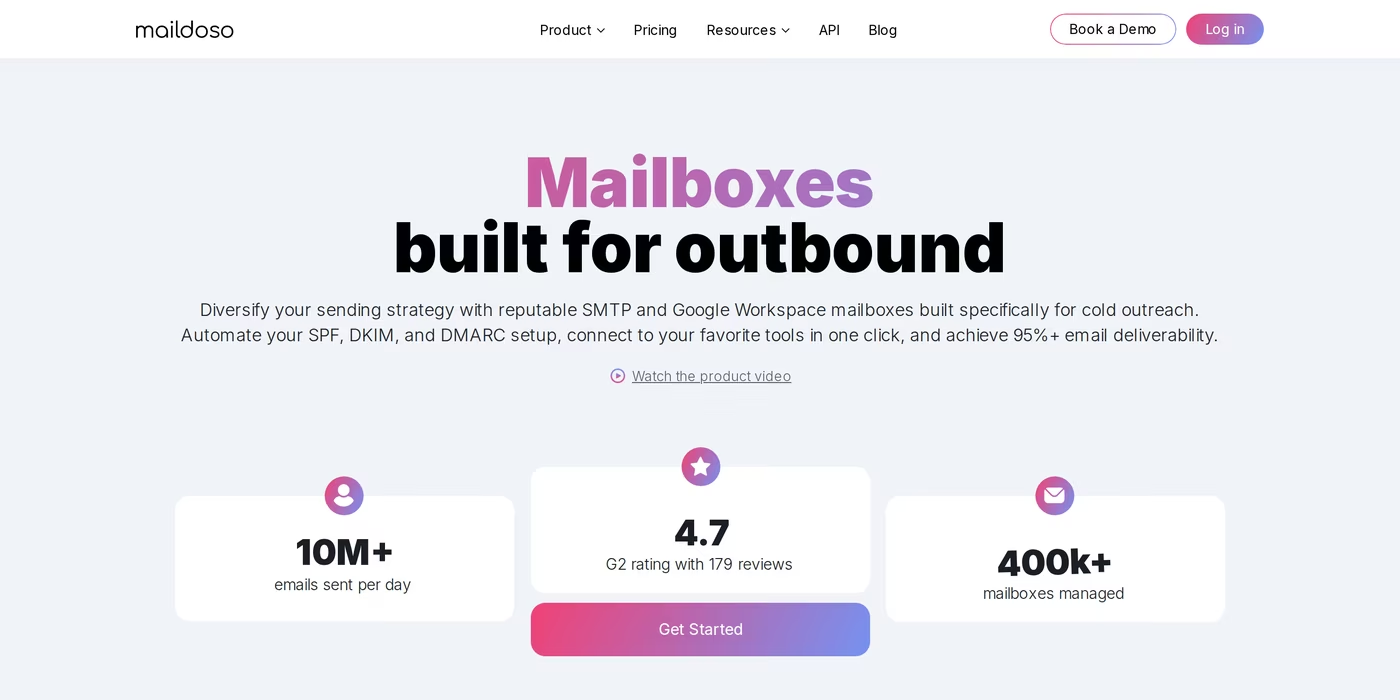
Maildoso is a cold email mailbox provider that sells its own SMTP infrastructure alongside Google Workspace mailboxes, with pricing built for volume. The homepage cites 10M+ emails sent per day, 400k+ mailboxes managed, and a 4.7 G2 rating across 179 reviews. There is no Microsoft 365 option; the company has said Microsoft mailboxes are on its roadmap.
Here is what Maildoso includes:
- SMTP and Google Workspace mailboxes. Sold separately or in combo plans that pair them in equal numbers.
- Automated DNS. SPF, DKIM, and DMARC configured per domain, with mailboxes live in about 15 minutes.
- 35 data centers with IP rotation. SMTP campaigns send from rotating IPs to reduce per-IP exposure.
- Self-healing mailboxes. Burned mailboxes pause for a 14-day cool-down, then return to rotation.
- Placement tests every 3 days. Each mailbox gets an automated check and a visible health score.
- Safe link insertion. Its link-replacement system lets you include links in a first email without exposing your main domain.
- Bulk sequencer connection. One-click connection of mailboxes to the major sending tools.
- 30-day money-back guarantee. The only refund window among the three providers here.
Maildoso pricing
Maildoso reworked its pricing recently, so older reviews describing quarterly-only billing are out of date. As of June 2026 the live page shows three families:
- Monthly combos: 15 GW + 15 SMTP at $90/mo, 35 + 35 at $175/mo, 150 + 150 at $675/mo. Combos require you to bring or buy domains (6, 14, and 60 respectively).
- Monthly SMTP: 30 mailboxes at $75/mo, 70 at $158/mo, 300 at $570/mo ($1.90 each).
- Quarterly SMTP: 32 mailboxes at $299/qtr up to 400 at $2,199/qtr ($1.80 each), with 8 to 100 domains included free.
What reviewers say about Maildoso
Maildoso has no Trustpilot page, and its critical reviews sit on G2, which blocks screenshots. So here is the documented pattern in plain text, with sources named:
- Burned domains replaced with low-trust TLDs. ScaledMail's comparison team and multiple r/coldemail threads record flagged domains being replaced with .xyz or .click instead of .com. Spamhaus has repeatedly listed both TLDs among the most spam-abused on the internet, so those replacements tend to get flagged again within weeks.
- SMTP placement variance. A third-party 100-mailbox test over three months measured 85-90% inbox placement on Maildoso SMTP against 92-95% on Google Workspace.
- Support response variability. Onboarding support is rated highly; critical G2 reviews cite slow resolution on persistent issues.
- Upfront cash at the cheap end. The lowest rates and free domains need quarterly prepay - $2,199 up front for the 400-mailbox tier, before you've tested your own list.
For balance: a 4.7 on G2 from 179 reviews is a strong score, and the complaints cluster on edge cases rather than the core product. I looked at Maildoso next to another budget provider in my Mailscale vs Maildoso comparison. Maildoso fits volume-first agencies with clean data who will never need Microsoft 365.
Primeforge Overview: Real Google and Microsoft Mailboxes Built for Cold Outreach
Primeforge is the Google Workspace and Microsoft 365 infrastructure product in the Forge Stack. The positioning line on its homepage is the cleanest summary of what it is: cold email mailboxes built for deliverability, not daily use. These aren't repurposed personal accounts, EDU-license workarounds, or grey-market reseller seats. They're full Google Workspace and Microsoft 365 mailboxes with full domain and mailbox ownership.
Here is what Primeforge includes:
- Real Google Workspace and real Microsoft 365. No EDU tricks, no loopholes that break when Google updates its policies.
- 30-minute setup. From signup to sending in half an hour, with SPF, DKIM, DMARC, and custom tracking domains configured automatically.
- Bulk DNS updates. Change records across hundreds of domains at once.
- Pre-warmed mailboxes available. Skip the cold start when a campaign can't wait.
- ESP Matching. Send Google-to-Google and Microsoft-to-Microsoft from one account, which lifts primary-inbox placement.
- Mailbox profile pictures and GIFs at scale. Sender identities configured out of the box.
- Multi-workspace organization. Separate workspaces per client or campaign.
- Works with any sending software. Standard OAuth into Instantly, Smartlead, Lemlist, Woodpecker, Salesforge, and others.
- Programmatic control. The Forge CLI and MCP server manage mailboxes, domains, and DNS checks from the terminal or an AI assistant - I covered the options in my roundup of MCP servers for email infrastructure.
- SOC 2 compliant. The only provider in this comparison with a published certification.
Primeforge claims its pricing runs 46% cheaper than buying Google Workspace direct and 25% cheaper than Microsoft 365 direct. It is one of three infrastructure options in the stack: Mailforge covers shared IPs at $2 to $3 per mailbox, and Infraforge covers dedicated IPs at $3 to $4. Warmforge handles warm-up across all of them. The stack publishes named results: ChannelCrawler ran Salesforge, Infraforge, and Warmforge to an 85.71% positive reply rate.
Primeforge pricing
$4.50 per mailbox per month, dropping to $3.50 at volume. Billing is monthly or annual, with two months free on annual. There are no plan tiers to outgrow and no quarterly lock-in.
Take Primeforge for a SpinHonest limitations
- No free trial. You pay per mailbox from day one. Maildoso's 30-day money-back window is the only refund cushion among the three.
- Not the cheapest line item. Mailforge shared IPs and bulk SMTP options cost less per mailbox. If your whole strategy is disposable SMTP volume at the lowest possible cost, Primeforge is the wrong product - it sells owned mailboxes, not bulk SMTP.
- Slower setup on paper. 30 minutes against the 10 to 15 minutes rivals advertise, though those rival figures cover provisioning only.
in Action
Head-to-Head Feature Comparison: Zapmail vs Maildoso
Mailbox types and ESP matching
Primeforge sells real Google Workspace and real Microsoft 365 under one account, with full ownership of both. That makes ESP Matching practical: send Google-to-Google and Microsoft-to-Microsoft, because inbox providers trust traffic from their own platforms more.
Zapmail sells both ESPs too, but Microsoft 365 sits outside the headline plans as a separate purchase, and community posts report its Microsoft mailboxes disconnecting more often than its Google ones. Maildoso has nothing on the Microsoft side. Its combos pair SMTP with Google Workspace, full stop. If your prospect list skews toward Outlook inboxes, that gap matters on day one.
IP infrastructure and deliverability
Maildoso runs 35 data centers with IP rotation and checks every mailbox with a placement test every 3 days - a real monitoring feature neither rival ships by default. The trade-off is the channel itself: the third-party test above measured 85-90% placement on its SMTP against 92-95% on Google Workspace.
Warm-up and pre-warmed inventory
Primeforge offers pre-warmed mailboxes and plugs into Warmforge for ongoing warm-up. Warmforge is free and unlimited with a Salesforge subscription, and the standalone version starts with one free warming slot and one free placement test.
Zapmail sells pre-warmed mailboxes as a paid add-on and does not bundle warm-up. Woodpecker's review also notes it gives you no placement tracking after launch. Maildoso publishes ramp-up guidance - 15 cold plus 25 warm-up emails a day per Google mailbox - but pre-warmed inventory is not a standard offer. My rule holds for all three: two weeks of warm-up before any campaign touches a new mailbox.
Domain ownership and replacement policies
With Primeforge you own the domain and the mailbox outright. When a domain burns, you decide what replaces it.
Maildoso's documented pattern runs the other way: burned domains replaced with .xyz and .click instead of .com, per ScaledMail's comparison team and community threads. Spamhaus has repeatedly listed both TLDs among the most spam-abused, so replacements tend to get flagged again fast. Maildoso's 14-day self-healing pause is a useful control, but it manages the symptom, not the TLD problem. Zapmail sells domains separately from $13 for a .com and hands over full admin access, which is a genuine point in its favor.
Compliance and security
Primeforge is SOC 2 compliant, with the badge published on its site. Neither Zapmail nor Maildoso publishes a SOC 2 certification as of June 2026.
For a solo sender that may not matter. For an agency putting client domains on rented infrastructure, it does, because security reviews increasingly ask for it. I would not put a regulated client's sending domains on infrastructure without a published SOC 2 report. Neither competitor can put that sentence on its own site today.
Automation, APIs, and AI workflows
Primeforge handles bulk DNS updates, separates clients into workspaces, and takes commands from the Forge CLI and MCP server. I've provisioned mailboxes and run DNS checks straight from an AI assistant - the walkthrough lives in my guide to setting up cold email infrastructure with Claude Code.
Zapmail's API is real but gated to the $299/mo Zapmail Pro plan. Its AI extras - domain name, mailbox name, and profile image generators - are handy for spinning up sender identities. Maildoso ships an API plus bulk one-click connection to the major sequencers. All three connect to Instantly and Smartlead; the difference is how much you can script without a human in the loop.
The Forge Stack around the mailboxes
Primeforge is one piece of a stack, and that's the part neither competitor can copy. Mailforge covers shared IPs when budget wins. Infraforge covers dedicated IPs - Woodpecker scaled past 2,500 mailboxes on it. Warmforge handles warm-up and Heat Score monitoring, and Leadsforge finds prospects across 500M+ contacts that Salesforge then sequences.
If you want the outreach run for you, Agent Frank is an AI SDR sold as a separate subscription from $499/mo billed quarterly - he prospects, writes, and books meetings inside the same stack. Zapmail and Maildoso are infrastructure layers only: solid at what they sell, with everything around them assembled from third parties.
Cold Email Mailbox Pricing Compared in 2026
All competitor numbers below come from the live Zapmail and Maildoso pricing pages, checked this week. Primeforge numbers come from its published per-mailbox rates.
| Level | Primeforge | Zapmail | Maildoso |
|---|---|---|---|
| Entry | $4.50/mailbox/mo, no plan tiers | Zapmail Starter: $39/mo, 10 Google mailboxes ($3.50/extra) | 30 SMTP at $75/mo, or 15 GW + 15 SMTP combo at $90/mo |
| Mid | Volume pricing moves toward $3.50/mailbox | Zapmail Growth: $99/mo, 30 mailboxes ($3.25/extra) | 35 GW + 35 SMTP combo at $175/mo |
| Scale | $3.50/mailbox at volume | Zapmail Pro: $299/mo, 100 mailboxes ($3.00/extra), API included | 150 GW + 150 SMTP at $675/mo; 400 SMTP at $2,199/qtr |
| Long-term discount | 2 months free on annual billing | Yearly billing lands near $2.50/mailbox at the top tier | Quarterly SMTP plans include 8 to 100 free domains |
| Refunds | Standard terms | No published refund window; reviewers report no refunds | 30-day money-back guarantee |
Two things stand out once you map the tiers. First, billing structure: Zapmail and Primeforge bill monthly with annual discounts, while Maildoso's lowest rates and free domains sit behind quarterly prepay. Second, what a "mailbox" means differs across the three columns: an owned Google or Microsoft mailbox, a resold Workspace seat, or shared SMTP.
Take a concrete 30-mailbox setup. On Primeforge that's $135/mo at the $4.50 entry rate, falling toward $105 as volume pricing applies. On Zapmail it's the $99/mo Zapmail Growth plan, with warm-up and domains (from $13 per .com) billed on top. On Maildoso it's $75/mo for 30 SMTP mailboxes, or $90/mo for the 15 + 15 combo, which needs 6 domains you bring or buy.
The cheapest sticker is Maildoso's. Given the placement numbers above, I'd price all three per inboxed email rather than per mailbox. For more provider teardowns at other price points, my ScaledMail alternatives roundup covers five more options.
Get Your Mailboxes Live in 30 MinutesWho Should Use Zapmail, Maildoso, or Primeforge
You might consider Zapmail if:
- Your budget caps near $39/mo and you're starting with 10 Google mailboxes.
- Your sequencer is on its 50+ OAuth integration list and you want one-click connection.
- You're comfortable with a reseller supply chain and don't need SOC 2 or a refund window.
You might consider Maildoso if:
- Your motion is volume SMTP and the $1.80 to $1.90 per-mailbox rates at the 300-400 tier fit it.
- You want free domains on quarterly SMTP plans and a 30-day money-back guarantee.
- You will never need Microsoft 365 mailboxes.
Choose Primeforge if:
- You need real, owned Google Workspace and Microsoft 365 mailboxes for client work, an outbound team, or an AI SDR pipeline.
- ESP Matching is part of your playbook: Google-to-Google and Microsoft-to-Microsoft from one account.
- A SOC 2 report has to survive a client's security review.
- You're scaling past 50 mailboxes and want bulk DNS updates and per-client workspaces.
- You want the rest of the stack native: Warmforge warm-up, Leadsforge data, Salesforge sending.
Still comparing? I keep a running list of Google and Microsoft mailbox providers in my Puzzle Inbox alternatives roundup.
Final Verdict: Which Cold Email Infrastructure to Choose
Zapmail and Maildoso are both real products with real customers. Zapmail is a fast, cheap reseller of Google and Microsoft seats with open questions about its supply chain and no published SOC 2. Maildoso is a volume SMTP shop with a Google Workspace option, no Microsoft 365, and a documented habit of replacing burned domains with low-trust TLDs.
For cold email infrastructure you own and can defend to a client, Primeforge is the stronger choice. Real Google Workspace and Microsoft 365 mailboxes from $4.50 down to $3.50 a month, SOC 2 compliance, automated DNS, and native Warmforge warm-up.
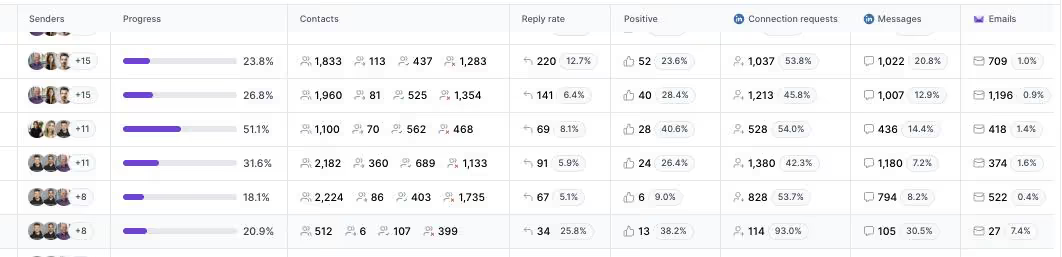
One falsifiable benchmark from the stack Primeforge plugs into: UniteSync ran Salesforge, Mailforge, and Warmforge to an 85.26% positive reply rate at a $2.86 CAC. The case study is public, and the screenshot below shows the kind of campaign data the stack produces.
FAQs About Zapmail, Maildoso, and Primeforge
Is Primeforge better than Zapmail and Maildoso?
For owned, compliant Google and Microsoft mailboxes, yes - Primeforge is the one I recommend of the three. It is the only one with published SOC 2 compliance and both ESPs under one account, at $4.50 down to $3.50 per mailbox per month. Zapmail and Maildoso are alternatives some teams look at for entry price or bulk SMTP. I've run the same exercise in my Zapmail vs InboxKit comparison, and the full set lives in the Salesforge comparisons library.
What's the main difference between Zapmail and Maildoso?
Zapmail resells real Google Workspace and Microsoft 365 accounts. Maildoso pairs its own SMTP infrastructure with Google Workspace and sells no Microsoft 365 at all. Zapmail prices flat tiers from $39/mo for 10 mailboxes. Maildoso prices combos from $90/mo for 15 Google plus 15 SMTP mailboxes, with quarterly SMTP plans that include free domains.
Which is cheaper: Zapmail, Maildoso, or Primeforge?
Maildoso has the lowest per-mailbox numbers on paper - SMTP drops to $1.80 to $1.90 at its 300-400 mailbox tiers. Zapmail's annual billing lands around $2.50 per Google mailbox at the top tier. Primeforge runs $4.50 down to $3.50. The three numbers buy different things: shared SMTP, resold Workspace seats, and owned Google/Microsoft mailboxes with SOC 2. I'd compare cost per inboxed email, not cost per mailbox.
Does Maildoso offer Microsoft 365 mailboxes?
No. Maildoso sells SMTP mailboxes and Google Workspace mailboxes, alone or in combo plans. The company has said Microsoft mailboxes are on its roadmap, but as of June 2026 there is no Microsoft 365 option at any tier. Primeforge and Zapmail both sell Microsoft 365, though Zapmail sells it separately from its headline plans.
Can I switch from Zapmail or Maildoso to Primeforge?
Yes. Primeforge mailboxes work with any sending software over standard OAuth, so you keep your sequencer and swap the infrastructure layer underneath it. New mailboxes are live in about 30 minutes with SPF, DKIM, and DMARC configured automatically. Plan a warm-up window before moving full volume - Warmforge handles that, and it is free and unlimited with a Salesforge subscription.
Do these providers include email warm-up?
Not in the base price, except through the Forge Stack. Zapmail sells warm-up and pre-warmed mailboxes as paid add-ons. Maildoso publishes ramp-up guidance - 15 cold plus 25 warm-up emails a day per Google mailbox - but pre-warmed inventory is not a standard offer. Primeforge has pre-warmed mailboxes available and connects to Warmforge, which includes one free warming slot standalone. You can also check placement free with the free cold outreach tools, including an inbox placement test.
Does Primeforge offer a free trial?
No free trial. Pricing is per mailbox - $4.50 down to $3.50 a month - billed monthly or annually with two months free on annual, and no quarterly lock-in. Maildoso offers a 30-day money-back guarantee instead of a trial. Zapmail is subscription-based with no published refund window.