If you landed on MailDeck's pricing page recently, you probably noticed the same thing I did.
Every tier shows a struck-through list price with a "Limited Offer" discount next to it. Three tiers are marked SOLD OUT. Those are Pre-Warmed Google Workspace, Pre-Warmed Private SMTP, and Leveraged SMTP.
That is the kind of signal that makes cold email teams nervous mid-scale.
MailDeck is a managed cold email infrastructure provider. It sells Microsoft Outlook, Google Workspace, private SMTP, and pre-warmed inbox stacks. It works. It has real customers sending millions of emails a month.
But the current pricing structure, the sold-out inventory, and the volume-heavy Diversified Stack tiers push a lot of solo senders and small agencies to look elsewhere.
Deliverability at scale is a technical responsibility, not a vendor loyalty test. If your provider is running out of stock or reshuffling prices every quarter, switching is the responsible move.
I compared six MailDeck alternatives across pricing model, mailbox type, IP setup, and setup speed. Some cover real Google Workspace and Microsoft 365 mailboxes. Others focus on shared or dedicated SMTP infrastructure. One is a multi-provider mix.
Here is the shortlist.
| Tool | Where It Beats MailDeck | Pricing |
|---|---|---|
| Primeforge | Real Google Workspace and Microsoft 365 mailboxes ready in 30 minutes with no sold-out tiers | Starts at $3.50/mailbox/mo (yearly) |
| Maildoso | Simplest self-serve pricing for SMTP-only sending at scale | Starts at $2.50/mailbox/mo (30-mailbox tier) |
| Mailforge | Cheapest shared-IP infrastructure for teams that already own their sending tool | Starts at $2/mailbox/mo (yearly) |
| ScaledMail | Flat-rate package pricing across Google, Outlook, and SMTP in one build | Starts at $3.50/mailbox/mo (Google) |
| Infraforge | Dedicated IPs and multi-IP provisioning for high-volume senders | Starts at $3/mailbox/mo (yearly) |
| Mailpool | Four infrastructure types under one dashboard for teams that want to mix | Starts at $3/inbox/mo (shared) |
I did not pick tools at random. Every option here handles the same three jobs MailDeck does. Provision the domain. Configure DNS. Deliver a working mailbox. Where they differ is how, how fast, and how much.
Cold email lives or dies on ESP diversity. Real Google Workspace and Microsoft 365 mailboxes behave differently in the inbox than SMTP-only setups. I weighted providers that give you both, or that let you mix mailbox types under one dashboard.
Some senders want managed and hands-off. Others want dedicated IPs and full reputation control. I flagged which tools give you shared IPs, which offer dedicated IPs, and where you can rotate across pools. If you want the deeper case on that trade-off, I broke it down in my Mailforge review on shared versus dedicated infrastructure.
MailDeck's homepage promises a three-stage deployment cycle. Every alternative here claims faster. I separated the ones that mean "signup to sending in 30 minutes" from the ones that mean "we ship your inboxes in 2 to 4 business days."
If you have to talk to sales just to see a real number, that is a red flag on a BoFU decision. I looked for public pricing calculators, fixed per-mailbox rates, and honest disclosure of what happens at scale. I also flagged anywhere pricing looked unstable or inconsistent on the same page.
Every tool claims 95%+ inbox placement. Nobody gets to take that on faith. I looked at G2 reviews, checked which tools publish DNS automation details, and noted where deliverability tooling is bundled in versus sold separately.
Here is the deeper breakdown of each tool. What it does well, where it falls short, and what the pricing actually looks like. All six are legitimate MailDeck alternatives depending on your setup.
Primeforge is the tool I keep coming back to when a team asks me for real Google Workspace or Microsoft 365 mailboxes without the manual admin work. The setup is genuinely fast. From signup to a fully configured mailbox with SPF, DKIM, and DMARC in place takes about 30 minutes.
What separates Primeforge from MailDeck is the mailbox itself. These are actual Google Workspace and Microsoft 365 accounts. Not resold pools. Not repurposed personal accounts. No EDU tricks or fragile setups that break the next time Google tightens its cold email policy.
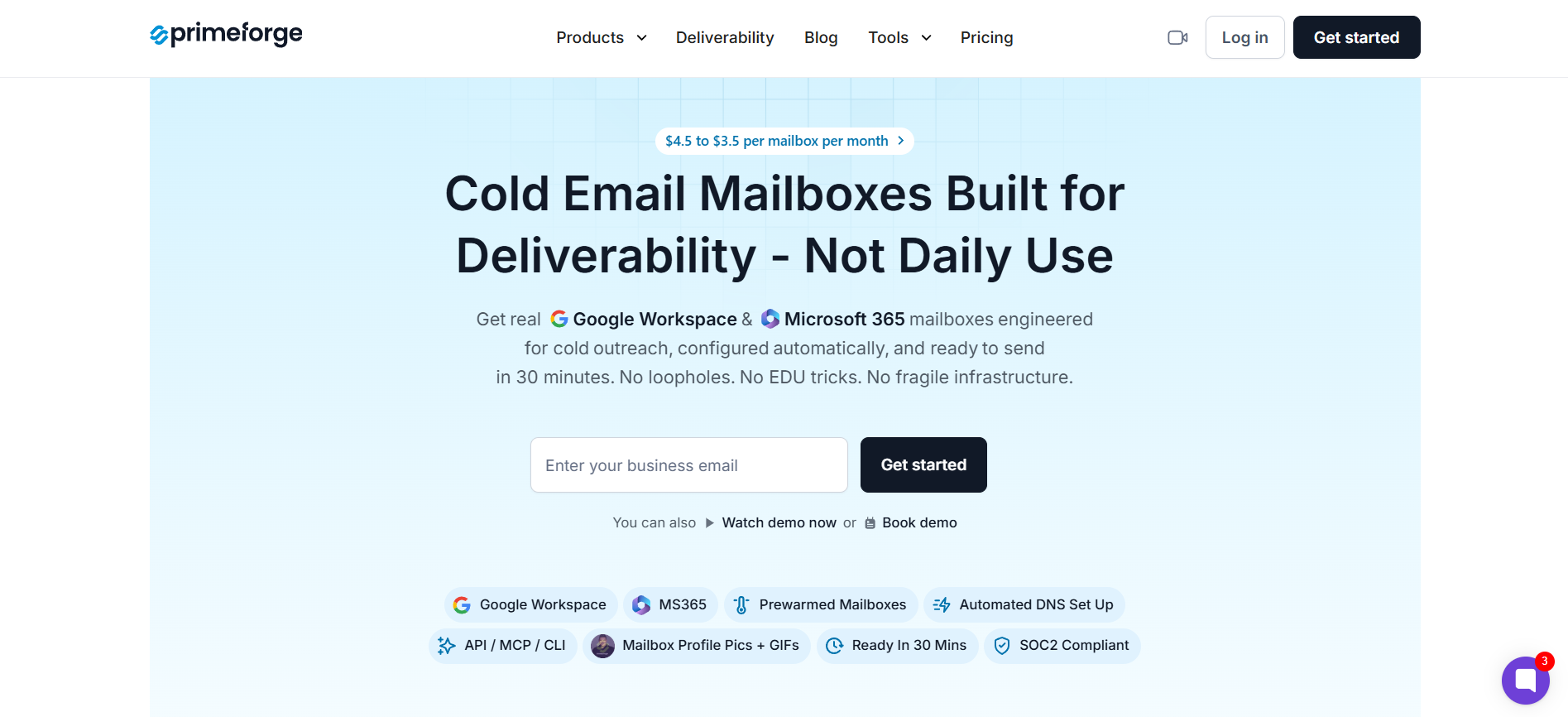
The pricing calculator is self-serve. You pick the number of mailboxes and domains, see a live price, and check out. No sales call required. If you want to see how it stacks up on the Google side specifically, my Google Workspace review walks through the raw math against buying direct.
| Plan | Price |
|---|---|
| Yearly Billing | Starts at $3.50/mailbox/mo |
| Monthly Billing | Starts at $4.50/mailbox/mo |
| Domains | $14/year per .com domain, charged once |
| Add-on | Forge Expert Double Session, $500 for two 1-on-1 sessions |
Pricing calculator on the site adjusts based on mailbox and domain volume. Verify live rates at time of purchase.
Maildoso is the closest MailDeck alternative if what you actually liked about MailDeck was the Private SMTP tier. The mechanics are similar. You pay per mailbox, the tool handles domain setup, DNS, and IP rotation, and you plug the inboxes into your sequencer.
What I noticed reviewing Maildoso is that the pricing scales aggressively downward at volume. At 30 mailboxes you pay $2.50 per mailbox. At 1,000 you pay $0.49. That makes it a strong pick for agencies or high-volume teams who never left the SMTP world.
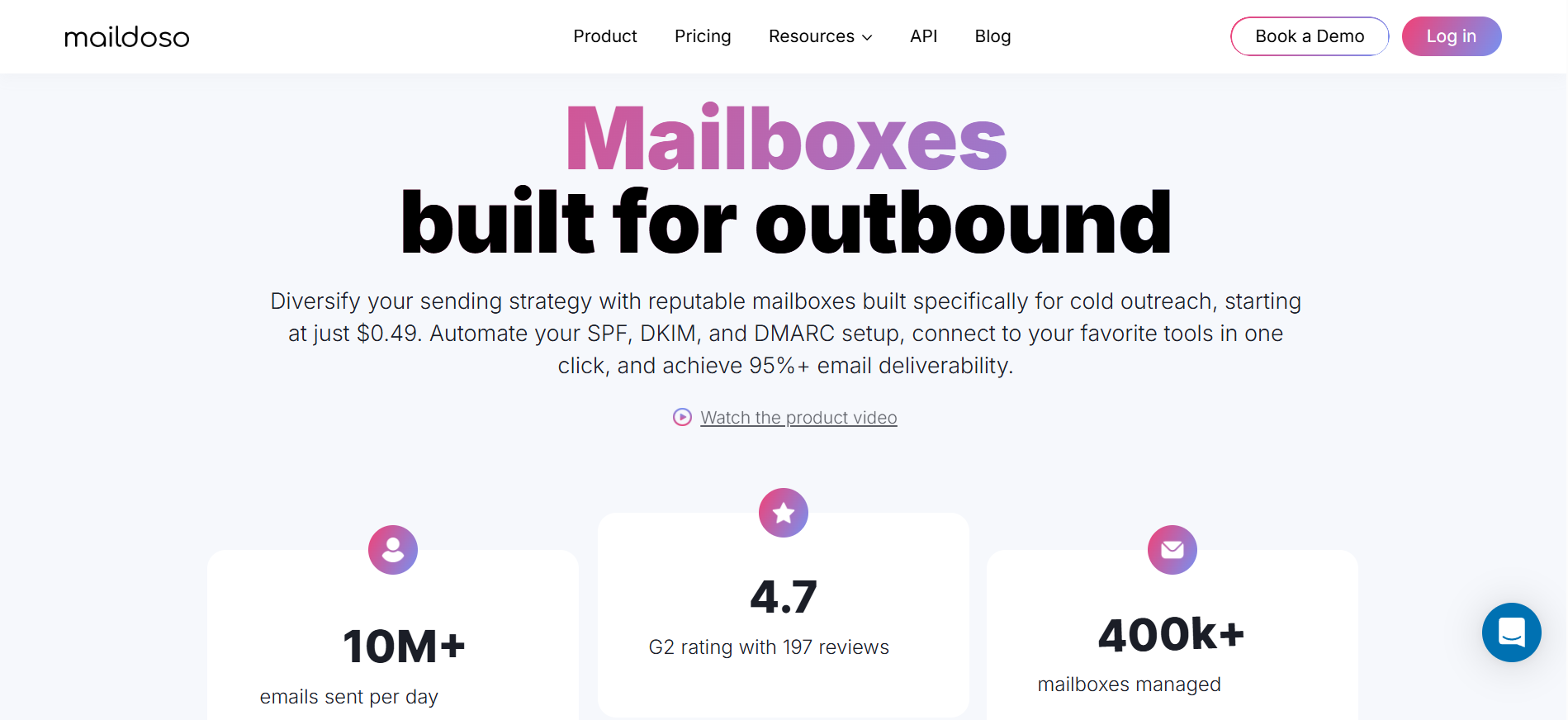
One important flag. Maildoso's Google Workspace product is currently marked unavailable on their own site. If Google mailboxes are non-negotiable for you, this is not the right pick right now. If you want the deeper breakdown across Google-first options, my Maildoso alternatives roundup covers that use case.
| Plan | Price |
|---|---|
| 30 Mailboxes | $2.50/mailbox/mo, $75/mo total |
| 300 Mailboxes | $0.75/mailbox/mo, $225/mo total |
| 1,000 Mailboxes | $0.49/mailbox/mo, $499/mo total |
| Custom Volume | Starts at $0.49/mailbox |
Mailforge is the cheapest way I have found to get proper cold email infrastructure without cutting corners on DNS or authentication. It runs on shared IPs specifically pooled with other cold email senders. That is a different model than Google or Outlook shared IPs, where you share pool space with random personal Gmail traffic.
Setup lives in the same pricing calculator format as Primeforge. You pick mailboxes and domains, see the price live, and check out. From signup to a working mailbox is about five minutes per their own claim. The reviews I read back that up in the 15-to-20-minute range for multi-mailbox setups.
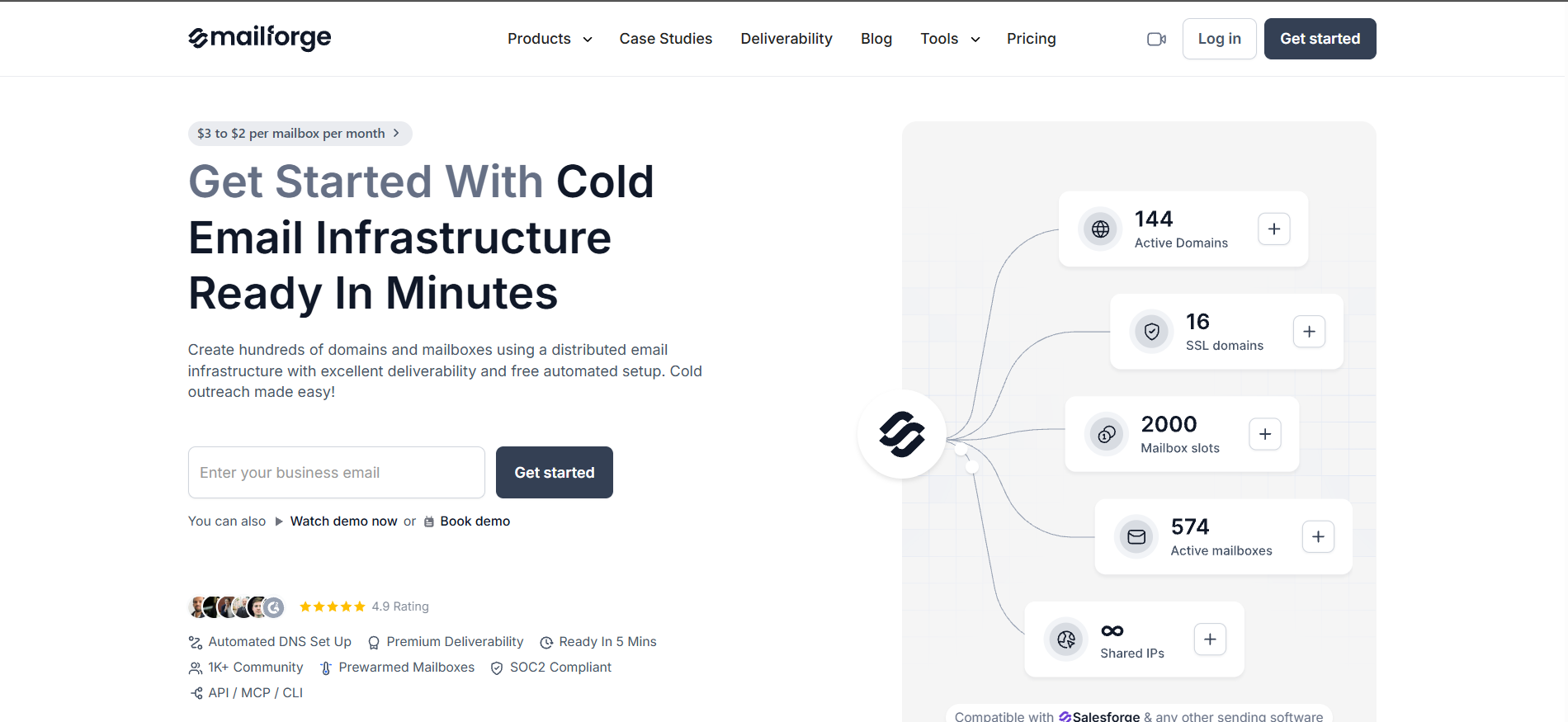
The main trade-off versus MailDeck is that Mailforge does not offer Google Workspace or Microsoft 365 mailboxes. This is domain-based SMTP infrastructure. If you want the sister-product context, my full Mailforge review covers where shared IPs make sense and where they do not.
| Plan | Price |
|---|---|
| Yearly Billing | Starts at $2/mailbox/mo |
| Monthly Billing | Starts at $3/mailbox/mo |
| Domains | $14/year per .com domain, charged once |
| Add-on | Forge Expert Double Session, $500 for two 1-on-1 sessions |
ScaledMail is the closest structural match to MailDeck's Diversified Stack, but with cleaner pricing. Instead of paying for a bundled "Starter Diversification" or "Growth Diversification" tier, you build a package. Pick Google Workspace at $3.50 per mailbox per month, Microsoft Outlook at $50 per domain per month, and SMTP at $3.75 per domain per month. Mix and match.
That flat-package model is what I would recommend if you liked MailDeck's multi-provider approach but hated the Limited Offer pricing dance. What you see is what you pay. No struck-through prices, no discount timer.

The trade-off is setup speed. ScaledMail says 2 to 4 business days for a package to go live, which is slower than the same-day setup you get from Primeforge, Mailforge, or Maildoso. If speed matters more than flat-rate simplicity, look at my ScaledMail alternatives breakdown instead.
| Plan | Price |
|---|---|
| Google Workspace | $3.50/mailbox/mo |
| Microsoft Outlook | $50/domain/mo |
| SMTP Server | $3.75/domain/mo |
| Reporting Add-on | $2 to $5 per mailbox or domain per month |
Infraforge is what I would recommend if the reason you were on MailDeck's Private SMTP tier was the dedicated IP promise. The model is different. You buy mailbox slots on dedicated IP infrastructure, get automated DNS, and can provision multiple IPs to protect reputation across campaigns.
The pricing calculator works the same way as Primeforge and Mailforge. Pick mailboxes and domains, see a live price. Starts at $3 per mailbox per month on yearly billing, which undercuts most dedicated-IP alternatives.
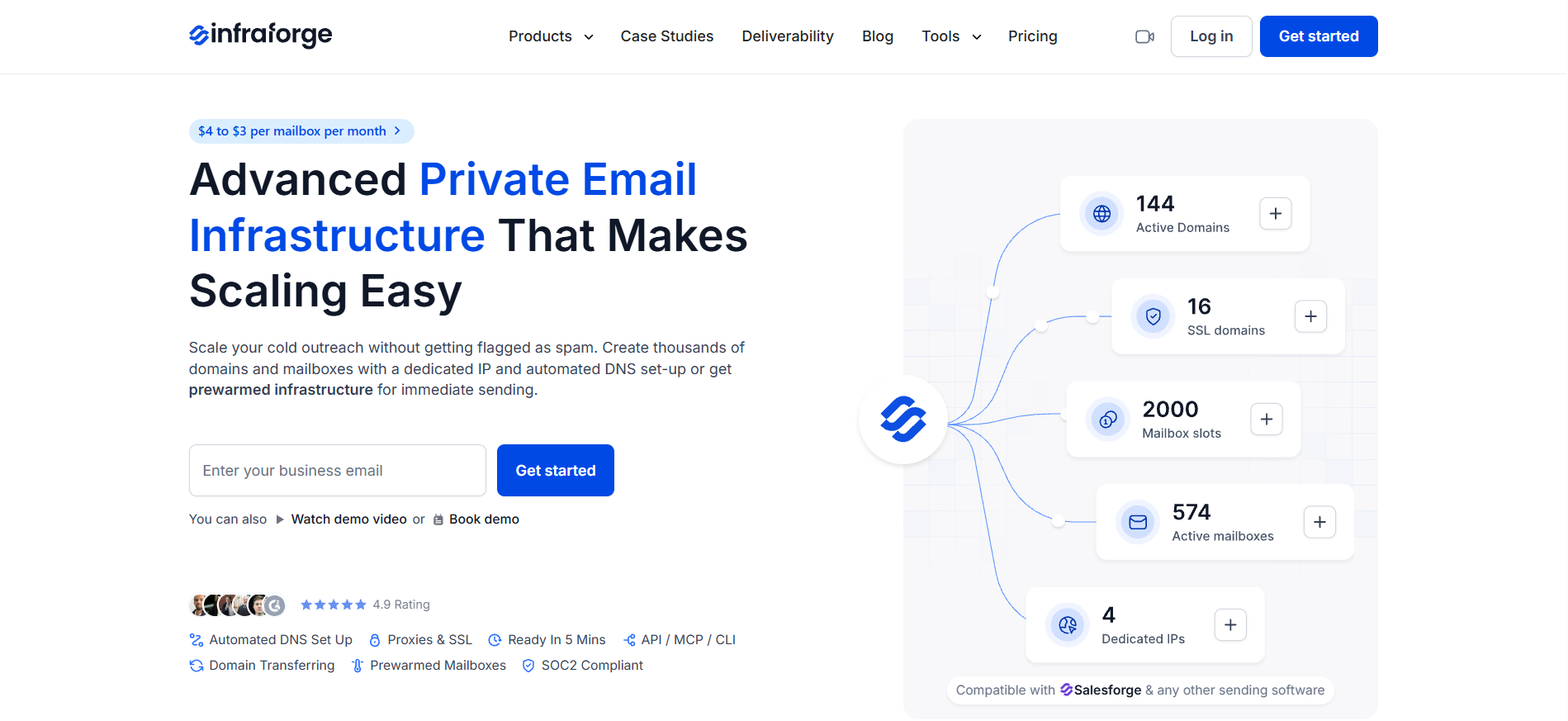
Since this is dedicated IP infrastructure, it is best for high-volume senders who need full control over sender reputation. If you send under 500 emails per day per domain, shared IP infrastructure like Mailforge is usually the cheaper choice. My guide on why you should diversify your cold email infrastructure covers when the dedicated-IP jump actually pays off.
| Plan | Price |
|---|---|
| Yearly Billing | Starts at $3/mailbox/mo |
| Quarterly Billing | Starts at $4/mailbox/mo |
| Domains | $14/year per .com domain, charged once |
| Add-on | Forge Expert Double Session, $500 for two 1-on-1 sessions |
Mailpool is the widest MailDeck alternative in terms of mailbox variety. Under one dashboard you get shared-IP SMTP inboxes, Google Workspace, Microsoft 365 Outlook, and dedicated-IP servers. That is broader than MailDeck's Outlook, Google, and SMTP split.
The AI Domain Generator is a nice touch. Bulk-import or bulk-purchase domains, and DNS is handled automatically. Setup is quick per the on-page claims, similar to the 5-to-15-minute range you get from other self-serve providers.
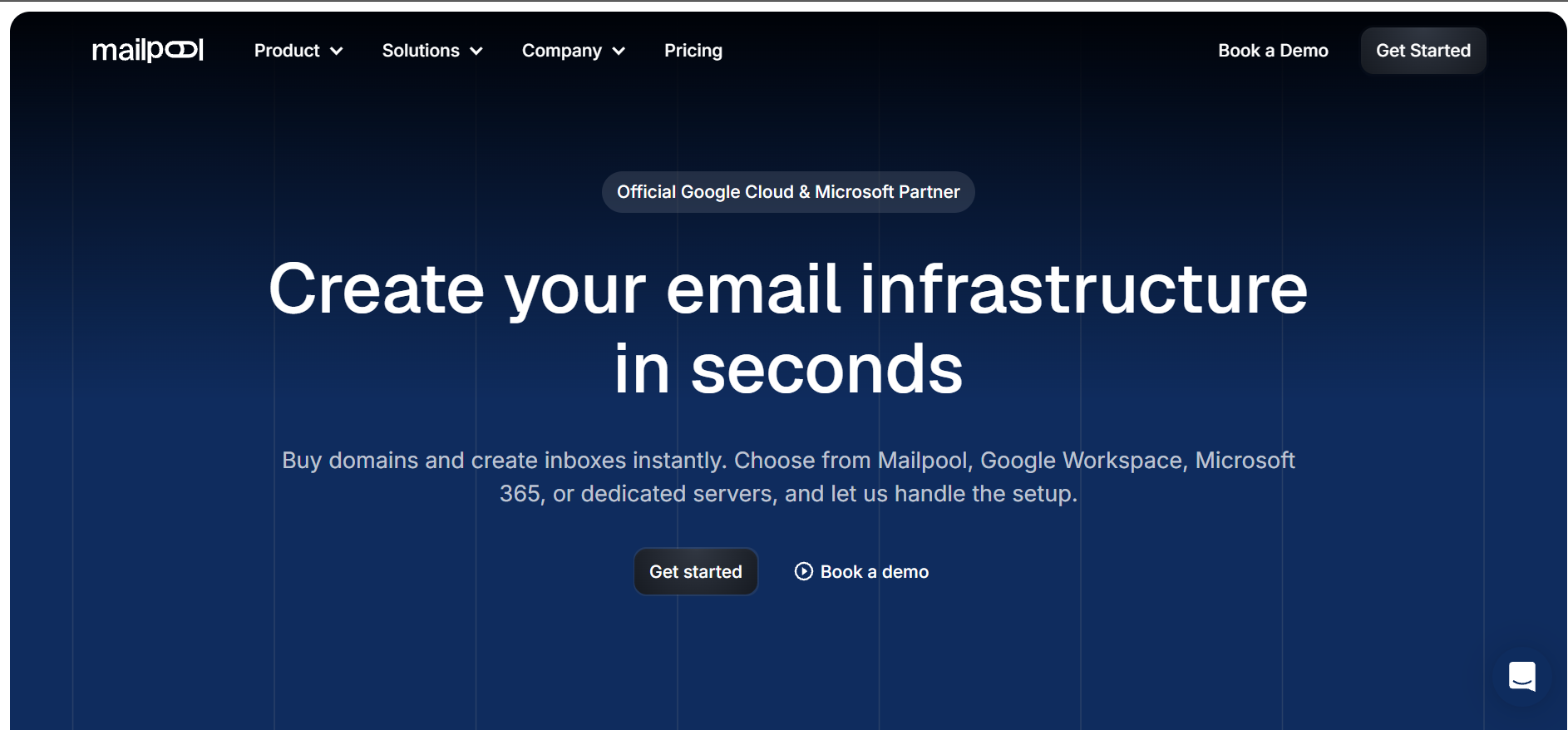
One flag worth naming. When I checked Mailpool's own pricing page, it shows two internally inconsistent price sets for the same plan names. The top card layout lists Mailpool inboxes at $3, Google at $4, and Microsoft at $5. Further down, the comparison matrix lists them at $2.60, $3.40, and $4.30. Both were live at the same time. Verify pricing with support before committing. For deeper context, my Mailpool alternatives comparison covers the trade-offs.
| Plan | Price |
|---|---|
| Mailpool Inboxes | Starts at $3/inbox/mo (top card) or $2.60/inbox/mo (comparison matrix) |
| Google Workspace | Starts at $4/inbox/mo or $3.40/inbox/mo |
| Microsoft 365 Outlook | Starts at $5/inbox/mo or $4.30/inbox/mo |
| Dedicated IP | $200/server/mo or $170/server/mo |
For most cold email teams switching from MailDeck, Primeforge is the pick. Real Google Workspace and Microsoft 365 mailboxes, self-serve pricing without the discount timer, and setup in 30 minutes.
Where Maildoso wins on SMTP volume pricing and Infraforge wins on dedicated IP control, Primeforge covers the use case most outbound teams actually have. If you need Google or Microsoft mailboxes ready today, start free with Primeforge and skip the queue.
Primeforge is the strongest option for real Google Workspace mailboxes. Setup takes about 30 minutes, DNS is automated, and you get actual Google Workspace accounts rather than resold pools or EDU-workaround setups. ScaledMail and Mailpool also offer Google Workspace, but with longer setup times or less pricing clarity.
At the time of writing, MailDeck's Pre-Warmed Google Workspace, Pre-Warmed Private SMTP, and Leveraged SMTP tiers are all marked SOLD OUT on their own pricing page. That signals inventory constraints on the pre-warmed pool. Verify current availability on MailDeck's site directly.
It depends on the tier. MailDeck's Diversified Stack Starter runs $99 per month discounted for 40,000 monthly sends across 5 domains. Primeforge starts at $3.50 per mailbox per month yearly. Mailforge starts at $2 per mailbox per month yearly. The right comparison depends on your mailbox count and volume, not list prices alone.
Primeforge and ScaledMail offer both real Google Workspace and Microsoft 365 mailboxes. Mailpool offers Google, Microsoft, plus shared and dedicated SMTP. Mailforge, Infraforge, and Maildoso are SMTP-focused and do not currently offer real ESP-branded mailboxes.
Primeforge, Mailforge, Infraforge, and Maildoso are all self-serve with same-day setup, typically 5 to 30 minutes. Mailpool is similar. ScaledMail is the outlier at 2 to 4 business days, since packages are manually provisioned by their team.
Infraforge is the best pick for high-volume senders who need dedicated IPs and multi-IP provisioning. Maildoso is the cheapest per-mailbox option at 1,000+ mailbox scale but is SMTP-only. Primeforge is the best pick if you need Google or Microsoft mailboxes at volume without the setup burden.