
Want to increase email engagement by 202%? Start with demographic data.
Demographic data transforms generic emails into personalized messages that resonate with your audience. Here’s why it matters:
This guide covers:
Personalization isn’t just a trend - it’s essential for better engagement and higher ROI. Let’s dive into how to use demographic data effectively.
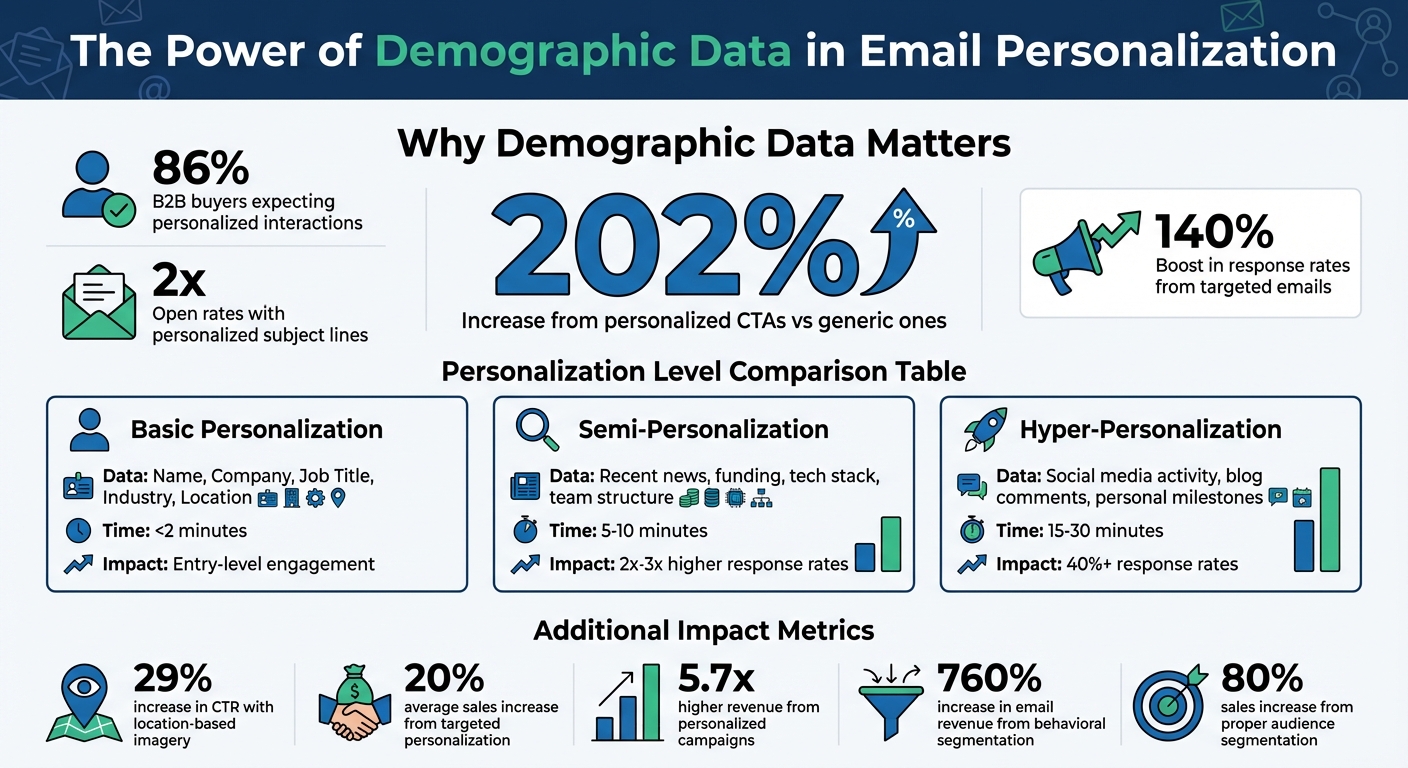
Email Personalization Statistics: Impact of Demographic Data on Engagement and ROI
The right demographic data can turn a cold email into a meaningful conversation. Below are the core data points that can help you create campaigns that truly connect with your audience.
Age plays a big role in shaping the tone and focus of your emails. For example, a 25-year-old startup founder might be drawn to fresh, forward-thinking content, while a 55-year-old executive may value messaging centered on long-term benefits. Adjust your language, references, and offers accordingly - think student discounts for younger audiences or retirement planning options for older ones.
Gender opens the door to personalized content that feels genuine. For instance, in 2025, Adidas used gender data in their Originals series to automatically display menswear to male subscribers and womenswear to female subscribers. This approach ensured that each recipient saw products tailored to their preferences. Many modern tools can now seamlessly customize visuals and product displays based on gender, creating a more personalized experience.
Location data allows you to add a regional touch to your emails. You can reference local weather, highlight nearby events, or tweak seasonal offers to match the recipient’s location. For instance, Campaign Monitor tested location-based imagery in emails sent to subscribers in the UK, USA, and Australia, which led to a 29% boost in click-through rates.
Beyond visuals, location data can help you use authentic regional language. A casual greeting suited to Texas might not resonate as well in New York. Plus, leveraging time zone information - like scheduling emails to hit inboxes at 9:00 AM in each recipient’s local time - ensures your message lands at the right moment. This timing is critical for maintaining excellent email deliverability and avoiding the spam folder.
Job title is a goldmine for crafting messages that speak directly to different stakeholders. A CFO may care most about ROI and cost savings, while a Technical Manager might focus on implementation specifics. When reaching out to multiple roles within a company, tailor your messaging to highlight benefits that matter most to each role.
Income level (or company revenue in B2B scenarios) can guide decisions about product positioning. High-income segments are often more open to premium options with advanced features, while those with tighter budgets may prefer affordable alternatives. Keep this insight behind the scenes to adjust pricing tiers or product lines subtly - explicitly mentioning income can come across as intrusive.
| Personalization Level | Data Points Used | Time Investment | Expected Impact |
|---|---|---|---|
| Basic | Name, Company, Job Title, Industry, Location | < 2 minutes | Entry-level engagement |
| Semi-Personalization | Recent news, funding, tech stack, team structure | 5–10 minutes | 2×–3× higher response rates |
| Hyper-Personalization | Social media activity, blog comments, personal milestones | 15–30 minutes | 40%+ response rates |
Next, we’ll explore how to ethically gather these valuable data points.
(function(d,u,ac){var s=d.createElement('script');s.type='text/javascript';s.src='https://a.omappapi.com/app/js/api.min.js';s.async=true;s.dataset.user=u;s.dataset.campaign=ac;d.getElementsByTagName('head')[0].appendChild(s);})(document,372145,'wzqrljsrcet38mumssx2');
Collecting demographic data responsibly is vital - not just for compliance with regulations but also for maintaining audience trust. Since 2018, GDPR fines have surpassed €4 billion, and CAN-SPAM violations can cost up to $51,744 per email. Beyond financial penalties, 66% of consumers will stop supporting a company if their data is shared without permission.
The cornerstone of ethical data collection is explicit consent. Regulations like GDPR and CCPA require that consent be freely given, specific, informed, and clear. Avoid using pre-checked boxes or hiding terms in lengthy agreements. Instead, use plain, direct language to explain what data you're collecting and why.
Another critical principle is data minimization. Collect only the information you genuinely need. For example, if age isn't necessary to personalize your emails, don't ask for it. This reduces privacy risks and demonstrates respect for your audience. As Ben Werdmuller from the News Product Alliance explains:
"If you can't explain the purpose, it's better not to collect it in the first place".
Transparency about data sources is equally important. Let users know where their data comes from and what they'll gain in return - such as curated content, exclusive deals, or tailored recommendations. This is especially critical as 63% of users are skeptical about how companies handle their data.
To maintain compliance, record each data point along with its consent timestamp. Allow users to opt out, processing requests within ten business days, and handle Data Subject Access Requests within the legally required 30–45 days. Conducting privacy audits at least once a year can help identify vulnerabilities and ensure your data practices remain secure.
Next, focus on gathering data directly from your audience using ethical, first-party methods.
First-party data - information gathered directly from your audience - is the most reliable and regulation-compliant way to personalize email campaigns. One of the simplest ways to collect this data is through signup forms on your website or landing pages. Keep these forms concise - limit the number of fields and make optional entries clear.
Interactive tools like quizzes, preference centers, and onboarding flows can also encourage users to share demographic details voluntarily. For instance, a preference center allows subscribers to choose how often they want to hear from you and what topics interest them, building trust while providing actionable insights.
Other effective methods include:
Once collected, this data should be integrated into a robust CRM system to streamline personalization.
Top CRM platforms like Salesforce, HubSpot, and Zoho CRM centralize data from various sources - web forms, email interactions, sales conversations, and support tickets - into unified profiles. This ensures your data is accurate, up-to-date, and easy to use.
Primeforge enhances cold outreach campaigns by seamlessly integrating with CRM systems. Its secure infrastructure supports compliance and deliverability, offering features like automated DNS setup and bulk DNS updates. With these tools, you can segment audiences by location, job title, or industry and schedule emails to land in inboxes at the right time, such as 9:00 AM in each recipient's time zone.
For managing user consent, Consent Management Platforms (CMPs) like OneTrust automate the process. These tools can tag subscribers by jurisdiction and apply region-specific data retention rules, ensuring compliance across varying privacy laws like CAN-SPAM in the US and GDPR in the EU.
For businesses dealing with sensitive data, Infraforge (part of The Forge Stack) offers private email infrastructure with dedicated servers. When paired with a CRM, this setup ensures demographic data stays encrypted and is only accessible to authorized personnel.
Finally, keep your email lists clean. Review them quarterly to remove inactive subscribers and validate data. This improves deliverability, protects your sender reputation, and ensures you’re only storing necessary information - a key principle of GDPR and CCPA compliance. Many modern CRMs include built-in tools for data validation and duplicate removal, making this task easier to manage.
Once you've gathered and organized demographic data, it’s time to transform those numbers into actionable strategies. This means creating buyer personas - detailed profiles of your ideal customers - and segmenting your audience into groups that receive targeted messaging. These steps are the backbone of any effective marketing campaign, ensuring your efforts hit the mark.
Start by collecting core demographic and firmographic data, such as age, gender, income, location, industry, company size, and revenue. For B2B campaigns, dig deeper into professional details like job titles, daily responsibilities, and success metrics. For instance, you might create a persona for tech directors aged 35–45 working at mid-sized SaaS companies.
Next, enrich this data with psychographics - insights into motivations, values, and decision-making styles. Tools like customer interviews and surveys can help you determine whether your audience leans toward being competitive (quick and logical), methodical (slow and analytical), or humanistic (relationship-driven). As Salesforce aptly puts it:
"Demographics? Good. Psychographics? Better. Demographics and psychographics? Best."
Add behavioral data from your CRM to round out your personas. This includes tracking email opens, website visits, content downloads, and purchase history to gauge where prospects are in their buying journey. Don’t forget to define negative personas - profiles of leads who are unlikely to convert. This helps your team avoid wasting time and resources.
Most companies start with three to five buyer personas and expand as they grow. Regular updates - at least annually - are essential to keep these profiles relevant. For example, in April 2025, UniteSync used tools like Salesforge and Mailforge to precisely target music creators with unclaimed royalties. Their persona-driven strategy resulted in an impressive 85.26% positive reply rate and a Customer Acquisition Cost (CAC) of just $2.86.
With well-defined personas in hand, you’re ready to move to the next step: segmenting your audience for personalized messaging.
Once your buyer personas are ready, use them to segment your email list. Start with basic segmentation by grouping contacts based on broad criteria like industry, company size, or location. For example, you could send ROI-focused content to C-suite executives while providing implementation guides to technical managers.
For a more advanced approach, leverage AI-driven tools to create real-time, dynamic lists. These lists update automatically based on factors like job changes, technology stack updates, or intent signals. Growth marketer Brianna Langley Henderson highlights the power of this approach:
"Customer segmentation will become more dynamic and fluid, adapting in real time to changes in segment behavior, market conditions, and competitive analyses."
Combining demographic data with behavioral insights allows you to segment by the buyer’s journey stage. For instance, send educational content to those in the awareness stage and case studies to prospects close to making a decision. Another effective tactic is ESP matching - sending emails from the recipient’s email provider (e.g., Gmail to Gmail) - to boost deliverability. Primeforge supports this method with tools like Google Workspace and Microsoft 365 mailboxes and automated DNS setup, making it easier to scale segmented outreach while maintaining high deliverability.
The impact of segmentation is clear. In 2025, e-commerce brand SwayChic used behavioral segmentation based on past purchases and site activity. The result? A 40% increase in open rates, double the click-through rates, and triple the email revenue. Behavioral segmentation strategies like these can drive email revenue up by 760% compared to non-segmented campaigns.
| Segmentation Strategy | Data Points | Best For |
|---|---|---|
| Demographic | Age, gender, location, income | B2C companies with diverse product lines |
| Psychographic | Lifestyle, interests, motivations | Products with multiple use cases or niches |
| Relationship | Funnel stage, customer tier, tenure | B2B software with long sales cycles |
| Behavioral | Email engagement, purchase history | Complex products that naturally collect data |
Once you've created personas and segmented your audience, demographic data becomes the key to crafting emails that feel personal. It allows you to fine-tune subject lines, content, offers, and CTAs to reflect what truly matters to each recipient. Here's how you can use these strategies to make your emails stand out.
The subject line is your email's first impression - it decides whether your message gets opened or ignored. To make it effective, keep it concise (under eight words) and in all lowercase, giving it a casual, conversational tone that feels more like a note from a colleague than a promotional email. This approach often works well for B2B outreach, driving better open rates.
Once the email is opened, dynamic content can take personalization to the next level. For instance, using location-specific imagery can increase click-through rates by 29%. Imagine tailoring visuals for different regions: a London skyline for UK subscribers or a New York City backdrop for US recipients. Adding seasonal or local references makes the email feel timely and relevant.
Keep the body of your email short and scannable - around 120 words is ideal. Use brief paragraphs (1-2 sentences) for easy readability, especially on mobile devices. Follow the "information scent" principle: your subject line should promise something valuable, and the opening sentence of your email must deliver on that promise. According to Campaign Monitor, 74% of marketers report that targeted personalization boosts customer engagement, with an average 20% increase in sales.
Personalized CTAs outperform generic ones by 202%. The secret lies in aligning your offer with the specific demographic you're targeting. For example, in location-based campaigns, using regional promotions or greetings like "Howdy" for Texas recipients can create an instant connection.
In B2B outreach, tailoring offers to career-specific needs works wonders. A Growth Marketer and a Content Marketer in the same company will have different priorities. Highlight scalability and ROI for the former, while focusing on performance metrics for the latter. Instead of immediately asking for a meeting, try the "Golden Carrot" approach. Offer something valuable yet low-commitment, like a custom Loom audit, a free report, or a case study featuring a similar client. This strategy can triple conversions to booked demos.
The level of commitment you request in your CTA should match the recipient's intent. For cold outreach, low-friction asks like "Open to a 5-minute video?" work well. For warmer leads, you can go bolder with "Book a 30-minute demo". Combining multiple personalization elements - such as a tailored subject line, dynamic content, and a customized CTA - can boost response rates by 140%.
Personalization doesn't just engage recipients; it also improves your email deliverability. By varying content based on demographic data, your emails look less like spam to email providers. High engagement rates signal to ESPs that your emails are welcome, enhancing your sender reputation. However, even the most personalized content needs the right infrastructure to succeed.
Primeforge steps in here with ESP matching, which sends emails from the same mailbox provider as the recipient (e.g., Google Workspace for Gmail users). This increases the likelihood of landing in the primary inbox. Primeforge also simplifies the technical setup with automated DNS configurations (DMARC, SPF, DKIM) and bulk DNS management. This streamlined process can save up to 46% in costs compared to manual setup.
"Cold email only works when it lands. That's where Salesforge and Mailforge have made the difference".
Once you've crafted tailored email content, the next step is to measure how well your campaign performs. This is where you can see the real payoff of using demographic targeting.
Tracking the right metrics takes the guesswork out of your efforts. For example, in 2025, cold email response rates typically range from 7%–10%, but with precise targeting, they can climb to over 20%. These numbers show how personalization can significantly boost engagement. Start by keeping an eye on key indicators like open rates (how enticing your subject lines are), click-through rates (if your content is hitting the mark), and response rates (actual engagement). Don’t stop at counting replies - hone in on positive responses that show genuine interest.
It’s not just about how many emails you send but how effective they are. Pay attention to booking rates (meetings scheduled as a result of your emails). Interestingly, about 60% of replies happen after the first follow-up rather than the initial email. A great example is UniteSync, which in 2025 achieved an 85.26% positive reply rate and a $2.86 Customer Acquisition Cost. They used tools like Salesforge, Mailforge, and Warmforge to keep their emails deliverable and effectively scale outreach to music creators about unclaimed royalties.
Here’s how standard campaigns stack up against personalized ones that use demographic data:
| Metric | Baseline (Generic) | Personalized Campaign |
|---|---|---|
| Reply Rate | 7%–10% | 20%+ (with precise targeting) |
| Open Rate Increase | Standard | +26% (with personalized subject lines) |
| Revenue Impact | Standard | 5.7x higher |
Take River Island, for instance. In 2025, the company used disciplined A/B testing to fine-tune its email strategy. The result? A 30.9% boost in revenue per email and a 26% increase in open rates - all while sending 22.5% fewer emails. The takeaway is clear: quality and precision outperform sheer volume.
To get the most out of your campaign, A/B testing is a must. It’s a systematic way to refine and improve your personalization.
Test one variable at a time - whether it’s the subject line, call-to-action (CTA), or sender name - to figure out what drives engagement. Run these tests over 7–14 days with sample groups of 1,000–5,000 subscribers to ensure your data is reliable. For example, just testing CTAs alone has been shown to increase click-through rates by 127%.
"Email marketing A/B testing resolves user issues, enhances UX, and drives business impact." – Rob Gaer, Senior Software Engineer, Miro
Be sure to document every test, including variations, results, and key insights. Wait 24–72 hours after sending before analyzing the results to account for the full response cycle. These findings help you fine-tune your demographic targeting, reinforcing the importance of precision and high-quality outreach. With 86% of B2B customers expecting personalization, continuous improvement is non-negotiable. Also, limit each mailbox to 30–50 emails per day to protect your sender reputation.
Using demographic data to tailor cold emails can transform overlooked campaigns into ones that deliver real results. Companies that focus on proper audience segmentation have reported sales increases of up to 80%. But success like this only happens when ethical data practices, smart segmentation strategies, and reliable infrastructure come together.
The numbers speak for themselves. Personalized calls-to-action outperform generic ones by a staggering 202%, but this level of success starts with a strong foundation. Begin by utilizing first-party data, creating detailed buyer personas, and segmenting your audience thoughtfully. And, of course, ensure your emails actually reach the inbox.
This is where having the right tools makes all the difference. Primeforge offers automated DNS setup and ESP matching to improve deliverability. Pairing Warmforge and Salesforge allows you to scale your outreach while safeguarding your sender reputation.
"Cold email only works when it lands. That's where Salesforge and Mailforge have made the difference." – Carlos Palop Moliner, CEO, UniteSync
Beyond infrastructure, continuous testing is key to optimizing your campaigns. Keep an eye on metrics like open rates, click-through rates, and positive reply rates - not just the number of emails sent. To protect your reputation, limit each mailbox to sending 30–50 emails per day. In the end, successful brands combine precise targeting with dependable delivery to stand out.
Demographic data lets you break down your audience into specific groups - think age, location, industry, or job role. Why does this matter? It allows you to craft subject lines, send times, and offers that feel personal instead of one-size-fits-all. Take this for example: "San Francisco SaaS founders: 3 growth hacks for 2025." That subject line speaks directly to its intended audience, making it far more likely to grab attention and drive opens.
Marketers who tailor their emails to match audience characteristics often enjoy open rates well above the 40% industry benchmark. The secret? Emails that align with recipients' interests and needs stand out in the sea of inbox clutter.
Primeforge makes demographic-based personalization effortless. Its email infrastructure is built for success, offering tools like automated DNS setup and dynamic merge fields to create personalized campaigns. Plus, it’s designed to work seamlessly with platforms like Salesforge and Warmforge, giving you the ability to test and fine-tune your demographic segments for better open rates and deeper engagement.
To gather demographic data responsibly, always rely on clear and consent-driven methods. Encourage prospects to share their information voluntarily through straightforward surveys, sign-up forms, or questionnaires. Be upfront about why you're collecting the data and how it will be used. Implement a double opt-in process to confirm consent and give recipients simple options to update or delete their information at any time. Stick to collecting only the necessary details - like age, gender, location, or income - that align directly with your campaign goals.
Steer clear of buying or scraping third-party lists, as these methods typically lack proper consent and can lead to trust and compliance issues. Ensure data is stored securely, document its origins, and promptly honor opt-out requests to stay in line with regulations like CAN-SPAM, GDPR, and CCPA. Offering something of value - like a free guide, discount, or contest entry - can also encourage participation and build trust with your audience.
For a streamlined approach, consider using Primeforge. This platform simplifies ethical data collection with features like automated double opt-in workflows, secure mailbox provisioning, and built-in compliance checks. It also supports DNS-managed domains, helping you maintain high deliverability rates and protect your brand’s reputation while enabling personalized, responsible email campaigns.
Segmenting your audience using demographic data means grouping potential customers based on shared traits like age, gender, income, education level, marital status, or location. This strategy helps you create messages that align with their life stage, preferences, and purchasing power.
To get started, gather accurate information from sources like LinkedIn profiles, company websites, or third-party tools, ensuring the data is clean and current. Once verified, categorize your leads into specific groups, such as "Millennial tech professionals in California earning $80,000–$120,000." These segments allow you to craft personalized email campaigns - adjusting subject lines, product suggestions, or tone - so your messaging strikes a chord. Studies show that tailoring content in this way can significantly improve open rates and engagement.
Primeforge streamlines this process with tools designed to manage verified lead lists, assign dedicated mailboxes to different segments, and safeguard your sender reputation with features like bulk DNS updates. Pair this with platforms like Salesforge to enhance demographic profiles and automate segmentation. Together, these tools ensure your outreach feels personal, maintains high deliverability, and transforms raw data into meaningful connections that drive real results.