
GDPR compliance is crucial for email outreach, especially when targeting EU residents. It requires companies to follow strict rules to protect personal data, including email addresses. Here's what you need to know:
Key takeaway: GDPR compliance isn't just about avoiding fines - it builds trust and improves outreach results. Follow these steps to stay compliant and boost your email performance.
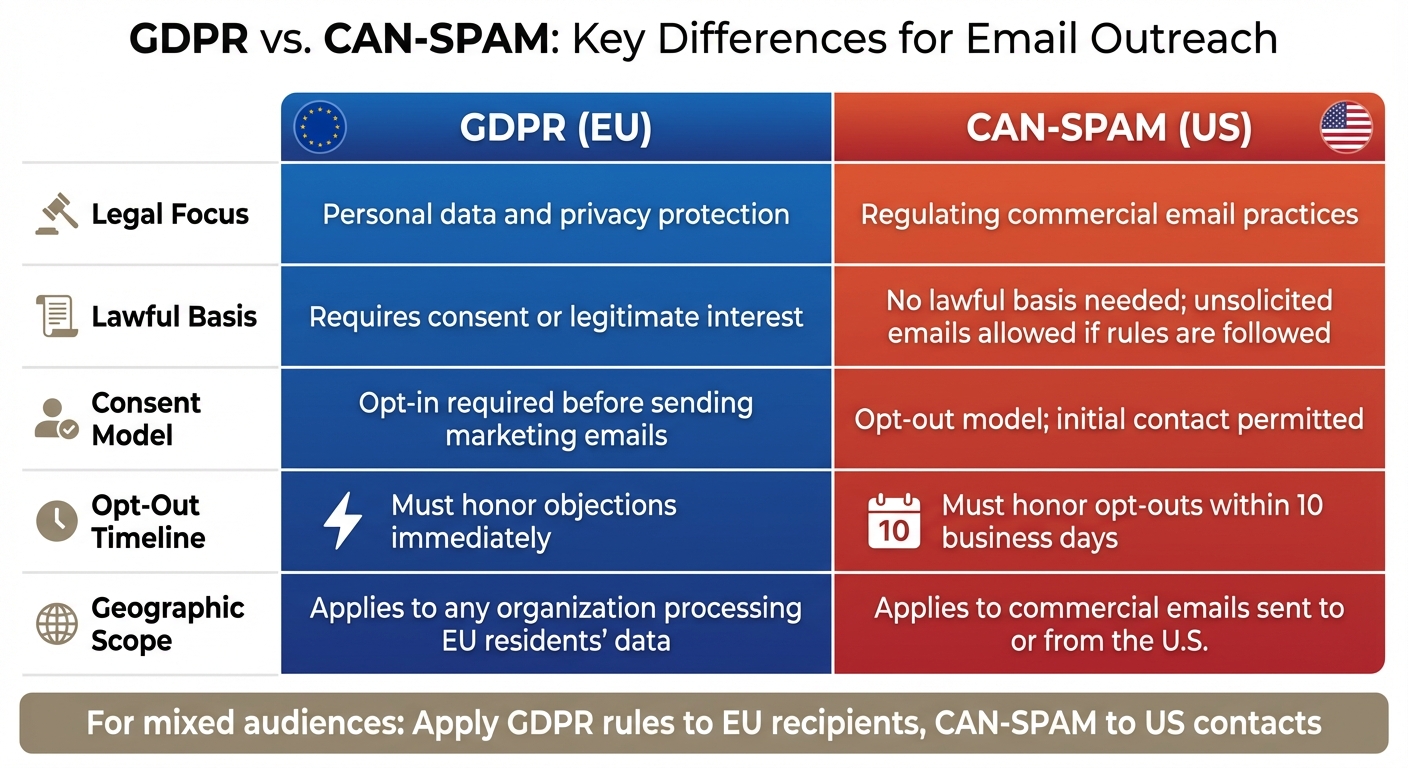
GDPR vs CAN-SPAM Email Compliance Requirements Comparison
When it comes to cold email outreach under GDPR, only two legal bases are practical: consent and legitimate interest. The other four lawful bases - contract necessity, legal obligation, vital interests, and public task - are rarely relevant if there's no prior relationship with the recipient.
Consent is best suited for ongoing marketing efforts like newsletters or automated email sequences. GDPR requires that consent be freely given, specific, informed, and unambiguous. This means recipients must explicitly opt in before receiving emails. Avoid using pre-checked boxes or bundling consent with other agreements.
Legitimate interest, on the other hand, is often used for targeted B2B cold outreach, especially when your product or service aligns with the recipient's professional role. For instance, reaching out to a marketing director about marketing software could qualify. To use this basis, conduct a legitimate interest assessment that demonstrates a genuine business need, the necessity of email contact, and that this need doesn't outweigh the recipient's privacy rights.
Here's an example: A U.S.-based SaaS company targeting revenue operations professionals might collect corporate email addresses via LinkedIn and send personalized messages with clear opt-out options. They document key details like their legitimate interest basis, when and where the data was collected, and a summary of their balancing test. This preparation helps them defend their outreach if challenged.
The main distinction between these two bases is simple: Consent requires an opt-in before any emails are sent, while legitimate interest allows initial contact, provided the outreach is relevant, personalized, and respects objections immediately.
Once you've established your legal basis, the next step is ensuring complete transparency with your recipients.
Transparency is a cornerstone of GDPR compliance, especially in email outreach. Every cold email must include the following elements:
For U.S.-based teams, using plain, straightforward language ensures your message is easy to understand for both U.S. and EU recipients.
Now, let’s take a look at how GDPR's stringent requirements compare to the more lenient CAN-SPAM regulations.
GDPR and CAN-SPAM take distinct approaches to regulating email outreach. CAN-SPAM, a U.S. law, allows unsolicited commercial emails as long as specific requirements are met. These include avoiding misleading subject lines, including a physical address, and providing a functional opt-out mechanism that must be honored within 10 business days. Importantly, consent is not required for the initial email under CAN-SPAM.
GDPR, however, prioritizes data protection and privacy. It requires a lawful basis - either consent or legitimate interest - before processing personal data, including sending marketing emails. GDPR also grants recipients extensive rights, such as accessing, correcting, and deleting their data, and the right to object to further communication. If a recipient objects, email contact must stop immediately.
Here’s a quick comparison:
| Aspect | GDPR (EU) | CAN-SPAM (US) |
|---|---|---|
| Legal Focus | Personal data and privacy protection | Regulating commercial email practices |
| Lawful Basis | Requires consent or legitimate interest | No lawful basis needed; unsolicited emails allowed if rules are followed |
| Consent Model | Opt-in required before sending marketing emails | Opt-out model; initial contact permitted |
| Opt-Out Timeline | Must honor objections immediately | Must honor opt-outs within 10 business days |
| Geographic Scope | Applies to any organization processing EU residents' data | Applies to commercial emails sent to or from the U.S. |
For businesses with mixed U.S. and EU contact lists, it’s crucial to segment your audience. Apply GDPR rules to EU recipients, even if U.S. contacts are managed under CAN-SPAM. This means documenting your lawful basis, being transparent, and promptly processing opt-out requests for EU recipients.
Understanding how prospect data moves through your systems is key to GDPR compliance. Start by mapping out where data is stored and how it flows - whether it's collected from LinkedIn, websites, or web forms. Document the lawful basis for collecting this data, such as consent or legitimate interest, and track how it transfers into your CRM, outreach platform, and backup systems.
At each step, set up compliance checkpoints. For instance, when collecting data, ensure you provide a privacy notice and record the lawful basis. Within your CRM, log the source of the data, establish retention rules, and monitor opt-out statuses. Before sending outreach emails, confirm that templates include necessary disclosures, unsubscribe links, and that suppression lists are properly applied. If you're storing EU prospect data on servers outside the EU (e.g., in the US), document safeguards like Standard Contractual Clauses. Additionally, create clear deletion protocols to handle erasure requests and routinely remove inactive leads.
GDPR also requires maintaining Records of Processing Activities (RoPA), which detail the purpose, data categories, recipients, transfers, retention periods, and security measures for every processing activity. Your data flow map forms the backbone of this documentation and should be updated whenever you add new tools or adjust workflows. This map can serve as evidence during compliance reviews or audits.
Once your data flows are mapped, the focus shifts to ensuring your email infrastructure provider supports GDPR compliance.
When it comes to GDPR, your email infrastructure provider - whether it's Google Workspace, Microsoft 365, or a specialized platform like Primeforge - acts as a data processor. As the data controller, you must ensure your chosen processor adheres to high data protection standards. Look for providers with strong DPAs, recognized security certifications (like ISO 27001 or ISO 27701), end-to-end encryption (both TLS and at-rest), robust access controls, and documented incident response plans. If data is transferred across borders, ensure safeguards like Standard Contractual Clauses are in place.
Understand where your email messages and logs are stored, and verify that your provider supports key authentication protocols like SPF, DKIM, and DMARC. Logging and audit trails for access and configuration changes, along with clear retention and deletion policies, are essential for minimizing data exposure. Administrative features like multi-factor authentication, role-based permissions, and centralized mailbox management further enhance compliance efforts.
If you're using direct mailboxes from Google Workspace or Microsoft 365, you may face challenges like fragmented control over sender domains, deliverability settings, and security policies. Specialized providers like Primeforge can simplify this process by offering dedicated outreach mailboxes that separate external communications from internal ones. Features like automated DNS setup - including bulk DNS updates - ensure consistent SPF, DKIM, and DMARC configurations across domains. Additionally, centralized management makes it easier to document infrastructure locations and apply uniform security measures.
Primeforge stands out by offering features tailored to simplify GDPR compliance.

Primeforge is designed to align with GDPR requirements through a range of practical features. Its automated DNS setup and bulk DNS updates make deploying SPF, DKIM, and DMARC across outreach domains seamless, reducing risks like spoofing or misdelivery. By supporting multiple workspaces and dedicated outreach mailboxes, Primeforge allows you to separate outreach activities from internal communications, ensuring limited access to prospect data and reinforcing data minimization principles.
Centralized mailbox management further enhances compliance by enabling role-based access control, consistent multi-factor authentication, and streamlined offboarding. Features like configurable mailbox profile pictures and consistent sending identities improve transparency, especially when paired with proper email signatures and privacy disclosures. As a distinct infrastructure layer, Primeforge allows you to document how outreach environments and IP ranges are secured and how they integrate with your CRM and other tools. This simplifies your Records of Processing Activities and makes compliance audits less daunting.
"Primeforge removes the fragility of cheap EDU accounts, loophole-based setups, or reseller panels with questionable compliance. You get legitimate Google/MS mailboxes, automated DNS with industry best practices, pre-warmed mailboxes ready to send safely, good-standing domains, and stable performance for high-volume or AI-driven sending." – Primeforge
With full domain and mailbox ownership, you retain control over your data processing - a key GDPR requirement. Primeforge’s focus on legitimate infrastructure and best practices helps mitigate risks like data breaches, misdelivery, or reputational harm, ensuring compliance and peace of mind.
To align with GDPR Article 32, it's essential to implement robust security measures to protect personal data during email outreach. Start by using SPF, DKIM, and DMARC to verify sender identity and reduce the chances of spoofing. Gradually move your DMARC policy from monitoring to enforcement - this approach can cut down domain spoofing by up to 90%, significantly lowering risks tied to phishing and impersonation.
TLS encryption is another crucial layer of protection, ensuring confidentiality and integrity of personal data as it moves between mail servers. For example, enabling "Require TLS" in platforms like Google Workspace or Microsoft 365, using updated cipher suites, and ensuring your CRM and outreach tools encrypt stored data are key steps. Regularly test your email security setup to confirm end-to-end encryption is functioning as intended.
Maintaining a good sending reputation is equally important. Use dedicated IPs and keep contact lists clean to avoid spam flags. A damaged IP reputation can push teams toward risky practices, increasing GDPR compliance risks.
Backup procedures must also meet GDPR's requirements for storage limitation and data integrity. Encrypt all outreach data backups, enforce retention policies to prevent keeping personal data longer than necessary, and tightly control access to restored backups. Include backups in your data deletion workflows and test restore procedures regularly to ensure both data security and availability.
These measures establish a secure foundation for email outreach and set the stage for effective access management.
Role-based access control (RBAC) ensures users only access what they need for their roles. By adopting a least-privilege approach, you can minimize unnecessary access. This includes disabling shared logins, creating individual user accounts, and assigning specific roles like "viewer", "sender", or "admin." Such granular permissions protect personal data more effectively.
Strengthen access security further by integrating outreach tools with corporate identity providers via single sign-on (SSO) and enforcing multi-factor authentication (MFA). Avoid shared passwords for common mailboxes (like sales@ or outreach@) by using delegation or group-based access. Track individual user activity and regularly review permissions, especially when team members join, change roles, or leave.
The importance of these measures is underscored by Verizon's 2024 Data Breach Investigations Report, which found that 74% of breaches involved human factors. Strong access controls, paired with security awareness, are critical for safeguarding email systems.
Primeforge takes security a step further by offering centralized management tools tailored for outreach. It streamlines DNS and mailbox management for platforms like Google Workspace and Microsoft 365, ensuring consistent security standards across your email infrastructure.
"For each mailbox you buy with Primeforge, we take care of setting up DMARC, SPF, DKIM and custom domain tracking, following industry best practices." – Primeforge
With features like API-based provisioning, administrators can standardize policies, control sending identities, and automate mailbox provisioning and deprovisioning. This ensures that only current, authorized users have access to outreach mailboxes, and access is promptly revoked when employees leave - reinforcing least-privilege practices.
By allowing users to retain full ownership of their domains and mailboxes, Primeforge provides greater control over data processing - an essential aspect of GDPR compliance.
"Primeforge takes care of all the technical deliverability details - SPF, DKIM, DMARC, domain warm-up, and DNS records - without me needing to touch anything." – Dominique W., Verified User
Accurate documentation plays a key role in maintaining GDPR compliance, especially when it comes to email outreach. According to GDPR Article 30, organizations must keep detailed Records of Processing Activities (RoPA). These records should cover every campaign or workflow, noting the purpose of processing (e.g., B2B lead generation), categories of data subjects, types of data collected (like names, work emails, and job titles), data flows (including systems or recipients), retention periods, and security measures in place. It's also important to document the legal basis for processing - whether it's legitimate interest or consent - and link it to relevant Legitimate Interest Assessments (LIAs).
Your CRM should capture essential details, such as the data source, acquisition date, and legal basis for processing. If consent is the basis, ensure you log specifics like the form name, timestamp, IP address, checkbox text, and the version of the privacy notice shown at the time. For opt-outs, record the date, method (e.g., link click or email reply), and remove contacts from communications promptly to avoid non-compliance.
Additionally, maintain Data Processing Agreements (DPAs) with all vendors involved in your email outreach, including mailbox providers, CRMs, and enrichment tools. These agreements should clarify roles (controller vs. processor), list subprocessors, outline security responsibilities, and specify data transfer mechanisms like Standard Contractual Clauses. If your campaigns involve profiling or automated decision-making - such as scoring leads based on behavior - conduct a Data Protection Impact Assessment (DPIA) before launching the initiative.
Once your documentation is in place, regular reviews are essential to ensure compliance remains up to date.
Set a schedule for quarterly reviews, along with an in-depth annual review, particularly for outreach targeting EU contacts. During these reviews, randomly sample campaigns to confirm that the legal basis for processing is well-documented. Check that privacy notices, disclosures, and unsubscribe links are current. Spot-check contact records to verify that data sources, consent proofs (if applicable), and opt-out enforcement are properly documented. Ensure your retention policies are followed - for example, by removing inactive contacts after 12–24 months.
Vendor and tool reviews should also be part of this process. Confirm that DPAs and data transfer mechanisms are still valid and that security settings, such as access controls and logging, align with your internal policies. Assign a specific person, such as a Privacy or Compliance Lead working with Marketing or Sales Operations, to document findings, corrective actions, and approvals. Remember, GDPR's accountability principle requires you to demonstrate compliance through evidence. Failing to maintain proper documentation could result in fines as high as 4% of your global annual turnover.
To complement these practices, ensure you have a solid plan for handling data breaches.
Under GDPR Article 33, personal data breaches must be reported to the relevant supervisory authority within 72 hours of detection - unless the breach is unlikely to pose any risk to individuals' rights. For breaches considered high risk, affected individuals must be notified immediately. For context, in 2023, over 1,800 breach notifications were submitted across EU member states, with roughly 15% involving email incidents.
A well-prepared breach response plan is essential. Assign a Data Protection Officer to oversee the process, log incidents, and assess risks within 24 hours of detection. The plan should include methods for detecting breaches (e.g., monitoring unauthorized access or unusual sending activity), investigation procedures to identify affected contacts and root causes, and templates for notifying both supervisory authorities and data subjects. Test this plan annually through tabletop exercises to ensure your team can respond quickly and effectively when needed.
| Breach Reporting Timeline | Action | Deadline |
|---|---|---|
| Awareness of Breach | Risk assessment | 24 hours internally |
| Notification to Supervisory Authority | If risk to individual rights | 72 hours |
| Data Subject Notification | If breach presents high risk | Immediately |
Achieving GDPR-compliant outreach isn’t about avoiding cold emails altogether - it’s about doing it the right way. The regulation requires you to establish a lawful basis for your outreach (often legitimate interest for B2B cold emails), focus on reaching relevant contacts, clearly explain who you are and why you’re contacting them, and promptly honor any opt-out requests. Following these steps not only helps you stay on the right side of the law but also boosts deliverability, response rates, and trust with your prospects.
Building a strong compliance framework starts with the right infrastructure and thorough documentation. Use dedicated business mailboxes with proper DNS authentication protocols like SPF, DKIM, and DMARC. Sign data processing agreements with all vendors, and maintain detailed records of your processing activities, legal basis assessments, and opt-out logs. Tools such as Primeforge can simplify this process by offering fully managed Google Workspace and Microsoft 365 mailboxes, automated DNS setup, and centralized management - addressing the limitations of less reliable reseller platforms.
GDPR compliance isn’t a one-and-done task. It’s a continuous process. Regularly review your campaigns, clean up your contact lists, train your team on data subject rights, and update your documentation as tools and regulations change. A practical workflow - including mapping data flows, using vetted infrastructure, creating compliant templates, and documenting every step - can be established in 30–60 days. This approach not only strengthens compliance but also improves your outreach performance. Comparing your practices to regulatory standards ensures you’re on the right track.
While CAN-SPAM focuses on opt-out options and accurate headers, GDPR sets a higher standard. It requires a valid legal basis, limits data collection, and emphasizes detailed documentation. For U.S.-based companies targeting EU prospects, meeting both sets of regulations is crucial. Businesses that comply with these standards often experience better engagement, fewer spam complaints, and stronger sender reputations in the long run.
When it comes to email outreach, GDPR and CAN-SPAM tackle different aspects of regulation. GDPR focuses heavily on safeguarding personal data. It requires businesses to obtain explicit consent before using or processing someone’s information. Additionally, it demands thorough documentation to ensure accountability and compliance with its rules.
In contrast, CAN-SPAM takes a more lenient approach. It permits unsolicited emails, provided they adhere to certain guidelines - like including accurate sender details and offering recipients a clear and easy way to opt out of future communications.
To put it simply, GDPR enforces stricter rules around privacy and consent, while CAN-SPAM centers on transparency and giving users control over their email preferences.
To meet GDPR requirements, businesses need to rely on email platforms that emphasize data security and privacy protections. Services like Primeforge make this process easier by automating the implementation of key email authentication protocols, including DMARC, SPF, and DKIM. These protocols not only safeguard email communications but also help ensure compliance with GDPR standards.
Using infrastructure with robust consent management tools can further minimize risks. Equally important is keeping thorough records of consent and data handling practices. Primeforge provides tailored solutions to simplify these tasks, enabling businesses to adhere to GDPR regulations while maintaining effective email campaigns.
To ensure your email campaigns comply with GDPR, start by maintaining detailed records of how and when you received consent from your recipients. This should include specifics like the exact timestamp and the consent wording they agreed to. It's also important to log all data processing activities, such as where the data comes from, how it's being used, and whether it's shared with any third parties. Regularly review and update these records to keep everything current.
Take time to evaluate your processes to confirm they meet GDPR guidelines, and make adjustments as needed. While tools like Primeforge can provide a secure and dependable email infrastructure to help with compliance, the cornerstone of GDPR adherence is keeping precise and comprehensive documentation.